AI needs a lot of power to think, but our current computer parts are as tiny and fast as they can possibly get. To build better computers in the future, new microelectronic materials are needed. My research uses first-principles calculations, symmetry analysis, and crystal-physics/chemistry models to simulate solid-state materials at the atomic scale, with the goal of understanding their underlying physics and designing new materials. The work runs along various materials classes:
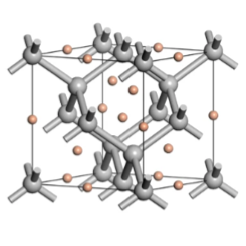
Semiconductors
Modern optoelectronic integration on chips needs materials that can emit light directly on a silicon platform. Group-IV semiconductors (Si, Ge) are intrinsically indirect-bandgap, with extremely low luminescence efficiency — a problem that has blocked CMOS-monolithic on-chip light sources for half a century.
Read more →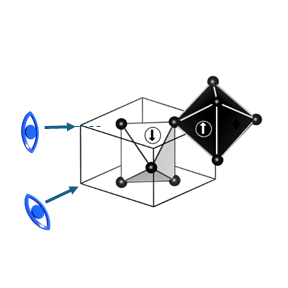
Novel magnetic materials
Antiferromagnets (AFMs) offer zero stray fields and terahertz spin dynamics, making them ideal for ultrafast, energy-efficient spintronics. Yet, their spin-degenerate bands have limited practical use.
Read more →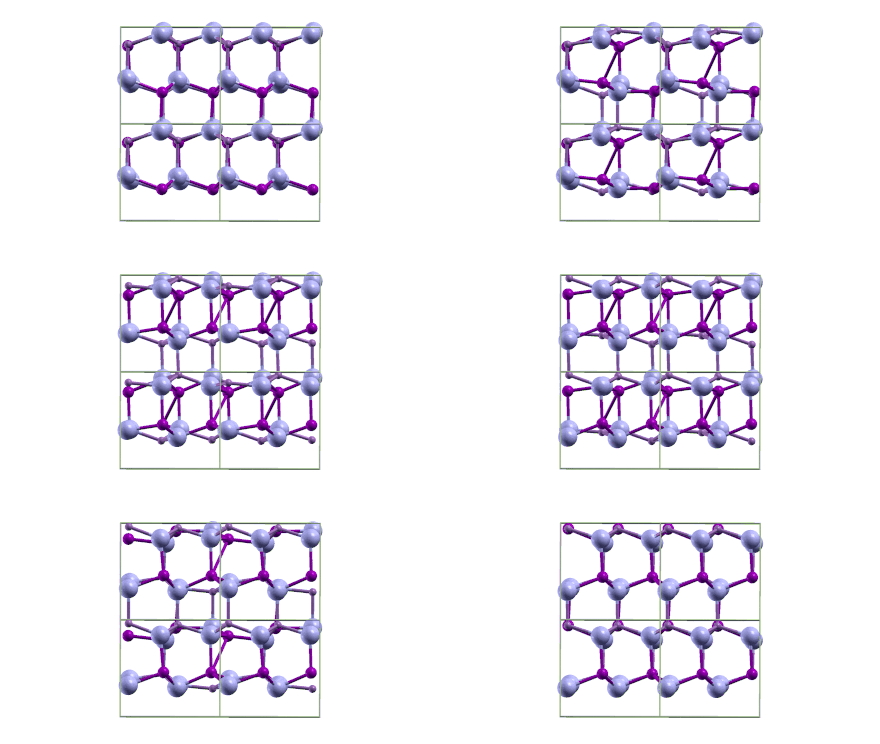
Ferroic materials
Ferroic materials, with intrinsic bistability and fast switching dynamics, have been pursued for decades as a pathway toward nonvolatile logic and memory. Despite decades of research, materials that combine multiple ferroic orders remain rare.
Read more →